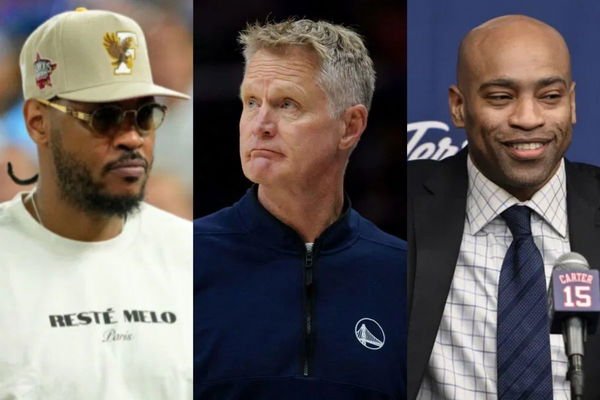
The debate over the NBA’s demanding 82-game regular season has intensified after Steve Kerr called for urgent discussions about shortening the schedule. The Golden State Warriors head coach believes the current format may be contributing to the growing number of player injuries around the league. However, not everyone agrees with his proposal.
During a discussion held at Madison Square Garden, former NBA stars Carmelo Anthony, Vince Carter, and Tracy McGrady examined the potential impact of reducing the schedule. Speaking as part of the NBA on NBC panel, the trio debated the financial, cultural, and competitive consequences of altering a format that has been in place since 1967.
### Economic concerns about reducing games
Carmelo Anthony was direct in his disagreement with the idea of cutting games from the schedule. He argued that the financial implications could be too significant for players to accept.
The NBA currently operates under a system in which Basketball Related Income (BRI)—the revenue generated by the league and its teams—is divided roughly equally between players and owners. Because salaries are tied to that revenue split, reducing the number of games would likely decrease overall league earnings and, in turn, player pay.
Anthony suggested that players might not be willing to sacrifice that income. For instance, a reduction of about 10 games—roughly 12 percent of the season—could cost a player a sizable portion of their salary.
To illustrate the potential impact, consider a star player like Stephen Curry. Curry is scheduled to earn approximately $59.6 million during the 2025–26 season. If the season were shortened by around 10 games and salaries were adjusted proportionally, he could lose between $7 million and $8 million in base pay.
The effect would not only be felt by superstars. Even players on smaller contracts could lose hundreds of thousands—or even millions—over the course of their careers unless the Collective Bargaining Agreement (CBA) were renegotiated to increase per-game pay or introduce other financial adjustments.
### The 82-game season as part of NBA tradition
Vince Carter also voiced opposition to altering the schedule, emphasizing that enduring the long season is part of what it means to play in the NBA.
Carter, who played 22 seasons in the league before his longevity record was later surpassed by LeBron James, described the demanding schedule as a rite of passage for professional players. According to him, athletes work tirelessly to reach the NBA, and handling an 80-plus game season has always been part of that challenge.
He questioned the need to modify a system that has defined the league for decades and contributed to its success.
### Kerr’s concerns fueled by injury struggles
Kerr’s push for change is largely influenced by the challenges his own team has faced this season. As of mid-March 2026, the Warriors rank among the NBA teams most affected by injuries.
Data from injury trackers shows the franchise has lost roughly $47.4 million in player availability due to injuries, placing them fifth in the league behind teams such as the Indiana Pacers, Dallas Mavericks, Memphis Grizzlies, and Portland Trail Blazers.
Curry has been particularly impacted. The Warriors’ star guard has missed 28 games because of a lingering right knee problem, including patellofemoral pain syndrome and bone bruising. Without him, Golden State has struggled, posting a 9–19 record in games he has missed.
These injury setbacks have strengthened Kerr’s belief that the schedule needs to be reconsidered.
### Kerr’s proposal for a 72-game season
Kerr has suggested reducing the regular season from 82 games to 72 in order to lessen the physical strain on players. He believes the modern style of play places greater physical demands on athletes than in previous eras.
Today’s NBA emphasizes a “pace-and-space” system that encourages faster tempo, frequent sprinting, and heavy perimeter shooting. This style contrasts sharply with earlier decades when the pace of play was slower and offenses relied more on inside scoring.
Statistics highlight this evolution. The average pace during the 2025–26 season is about 99.3 possessions per game, significantly higher than the low-to-mid 90s pace common during the early 2000s.
Three-point shooting has also surged. Teams now attempt approximately 35 to 37 three-pointers per game, compared to around 15 to 16 attempts in the 2000s and fewer than 12 per game during the 1990s. The added movement and increased distance players must cover during games may contribute to greater wear and tear across a long season.
Kerr has even called for a formal meeting with NBA commissioner Adam Silver and league officials to discuss whether shortening the schedule could help address the injury issue.
### Former players offer an alternative perspective
Although Tracy McGrady acknowledged there are advantages and disadvantages to reducing the schedule—such as eliminating back-to-back games that often lead to player rest—he and his fellow panelists ultimately leaned toward maintaining the current format.
Carmelo Anthony suggested that the increase in injuries might stem more from modern training methods and player preparation rather than the schedule itself. According to him, earlier generations of players adapted to the demanding schedule and used it as an opportunity to better understand their bodies and develop resilience.
McGrady proposed a different approach instead of shortening the season. He suggested that retired players could help teach the current generation how to prepare physically for the grind of an 82-game schedule.
His idea was that former stars could share their training techniques and preparation strategies from earlier eras to help younger players stay healthy throughout the season.
### A difficult decision for the league
Despite the ongoing discussion, changing the schedule would not be easy. The current system, including the 50-50 revenue split between players and team owners, is built into the league’s Collective Bargaining Agreement.
Reducing the number of games would require significant renegotiations of that agreement. Many analysts believe team owners would be reluctant to accept such changes because fewer games would likely mean lower revenue from ticket sales, broadcasting deals, and sponsorships.
For now, Kerr’s proposal has sparked a wider debate across the basketball world. While some see a shorter schedule as a way to protect players’ health, others believe the traditional 82-game season remains a fundamental part of the NBA’s identity and financial structure.