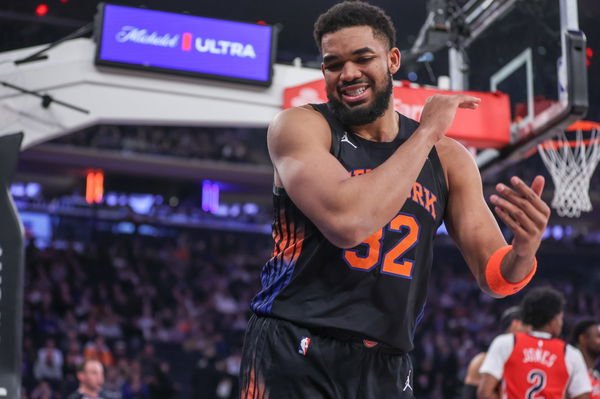
With the playoffs less than three weeks away, the New York Knicks are facing a concern that goes beyond a single loss. After their 111–100 defeat to the Oklahoma City Thunder on Sunday, Karl-Anthony Towns drew attention for openly admitting that he is still unsure of how he best fits into the team’s system this late in the season.
Towns finished the game with 15 points and 18 rebounds, and while the Knicks were competitive for most of the night—trailing by just two points with four minutes remaining—they ultimately fell apart down the stretch. Despite the solid stat line, Towns made it clear that the deeper issue is about his role and impact, not just numbers. He acknowledged that he is still trying to determine how he can most effectively contribute to winning.
The game itself reflected that uncertainty. Alex Caruso limited Towns significantly in the first half, holding him to just four points on a single shot attempt across 22 minutes. Even though the Knicks were only down 53–52 at halftime, Towns had minimal offensive influence early on. By the time he became more involved in the fourth quarter, the Thunder had already established control through their depth and defensive consistency.
Oklahoma City utilized a 12-man rotation compared to New York’s nine players, allowing them to maintain high defensive energy throughout the game. This exposed the Knicks’ dependence on their key players to dictate offense. When Towns was effectively neutralized early, the team struggled to maintain offensive balance—reinforcing his own admission about lacking a consistent way to impact the game when his primary options are taken away.
This uncertainty isn’t isolated to Towns alone. Just days earlier, during a loss to the Charlotte Hornets, head coach Mike Brown benched Towns in the fourth quarter, opting instead for Mitchell Robinson due to his defensive presence and rebounding. The move highlighted that while scoring struggles can be tolerated, inconsistency and defensive weaknesses are harder to overlook.
Brown has also admitted that the adjustment process is mutual, noting that he has had to adapt his approach to better integrate Towns. Those adjustments paid off briefly, as Towns put together a strong stretch in March, recording six consecutive double-doubles and averaging over 20 points and nearly 13 rebounds. However, maintaining that level of consistency remains a challenge.
Criticism has also come from outside voices. Former NBA star Tracy McGrady questioned Towns’ mentality, suggesting that his success depends on how strongly he asserts himself. McGrady emphasized that Towns has the talent to be unstoppable but needs a more aggressive and determined mindset to fully capitalize on it.
He also pointed to a broader issue with the Knicks, suggesting that the team has lost the defensive identity it once had under former coach Tom Thibodeau. Despite holding a strong 48–27 record and sitting third in the Eastern Conference, recent losses have reignited concerns that were temporarily quieted during their seven-game winning streak in March.
Coach Brown has been working to simplify Towns’ role, aiming to replicate the style he played with the Minnesota Timberwolves by getting him into familiar positions and reducing complexity in decision-making. This approach showed promise during their winning run but struggled against a disciplined Thunder defense.
Situations like this are not uncommon for star big men adjusting roles. Chris Bosh experienced a similar transition when he joined the Miami Heat, shifting from a primary scorer to a complementary piece alongside LeBron James and Dwyane Wade. Initially, there were doubts about his fit, but once he embraced a more versatile role focused on spacing, defense, and timing, the team reached its championship potential.
Towns now faces a comparable moment in his career. His talent is unquestioned, but finding a clear and consistent role is critical. While players like Jalen Brunson and Mikal Bridges can carry the Knicks at times, the team’s true ceiling depends on Towns establishing his identity within the system. The potential is there—the challenge is turning it into consistent impact before the playoffs begin.