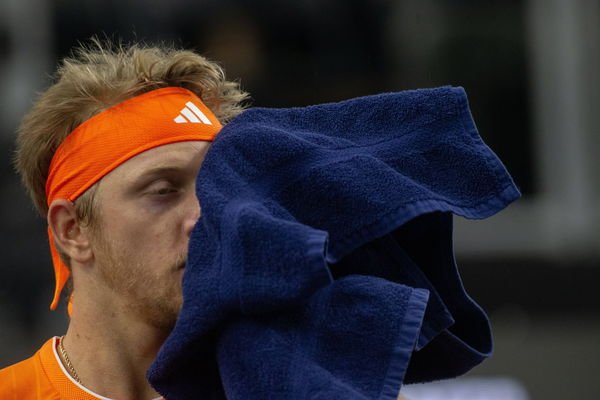
Tensions over time-related rules in tennis have recently become a major talking point. Earlier in the season, Carlos Alcaraz criticized officials after receiving a penalty simply for reaching for his towel during the Qatar Open. He later raised similar concerns directly with the ATP during the BNP Paribas Open at Indian Wells Tennis Garden. Now, at the same tournament often referred to as “Tennis Paradise,” another controversy surrounding time rules has emerged—this time involving Alejandro Davidovich Fokina.
The Spanish player expressed frustration during his match against Jakub Menšík despite eventually winning 6–2, 4–6, 6–2. Davidovich believed the rules regarding time between points were not being enforced consistently, accusing his opponent of repeatedly delaying play without receiving a warning.
Davidovich began the match in dominant fashion. He controlled the opening set with aggressive shot-making and dictated most of the rallies. His strong start allowed him to take the first set comfortably while Menšík appeared to struggle physically. Reports indicated the Czech player might have been dealing with respiratory issues, possibly related to cold symptoms. At one point during the match, medical staff even checked on him.
Initially, Davidovich maintained his focus and continued applying pressure. However, the match’s momentum shifted during the second set. With the score at 4–3 in his favor and holding a break advantage, the Spaniard appeared to be in a strong position to close out the match in straight sets.
At that stage, frustration began to build. Davidovich complained to the chair umpire about Menšík taking too long between points without receiving a time violation. According to the Spaniard, his opponent repeatedly delayed the restart of play, but the umpire did not enforce the shot clock.
Up until that moment, Davidovich had not faced a single break point. Yet when he stepped up to serve at 4–3, the match suddenly turned against him. He lost four consecutive games, allowing Menšík to capture the second set 6–4.
After the set ended, Menšík briefly left the court for a bathroom break, adding further tension to an already heated situation. The atmosphere had clearly shifted, and the contest had become much more complicated.
During his exchange with the umpire, Davidovich openly voiced his anger. He claimed that Menšík was moving around the court and repeatedly asking him to stop while the official failed to restart the shot clock. At one point, the Spaniard waited to serve even though the allotted time had already expired, while Menšík continued walking around on his side of the court.
Davidovich said he had never seen such a situation before and felt the time regulations were not being applied fairly. The frustration appeared to affect his game as well. He began committing unforced errors and seemed distracted by the ongoing dispute and his suspicion that his opponent might be exaggerating physical discomfort.
Eventually, the match moved into a deciding third set. Davidovich managed to regain his composure and reestablish control over the contest. He opened the set with an early break but soon faced danger when Menšík created a 0–40 opportunity on his serve.
The Spaniard responded by saving those break points and stabilizing his performance. He then pushed aggressively on return and secured another break, which ultimately proved decisive. From there, Davidovich maintained his advantage and closed out the match to secure victory.
His win set up a next-round meeting with Learner Tien. The American rising star had advanced after producing a surprise upset over Ben Shelton with a 7–6(3), 4–6, 6–3 result earlier in the tournament.
For Davidovich, disagreements with umpires over time-related rulings are not entirely new. Similar situations have occurred during other tournaments in his career.
One notable incident happened during the 2025 Australian Open in a match against Felix Auger-Aliassime. That encounter turned into an extremely long and exhausting contest. With the score at 2–3 in the final set, the chair umpire issued Davidovich a time violation.
The call immediately angered the Spaniard. He approached the umpire’s chair and began arguing about the decision. His frustration escalated to the point where he temporarily refused to continue playing. The match had already lasted four hours and 37 minutes, adding to the physical and mental strain.
Earlier in that same match, play had even been relocated to a different court because noise from another nearby match was disrupting the game. After the lengthy delays and intense battle, Davidovich struggled to accept the penalty.
Eventually, another official stepped in to calm the situation and encourage him to continue the match.
Another tense moment involving the Spaniard occurred during the 2025 Eastbourne Open, again against Menšík. At that time, Davidovich trailed 5–4 in the second set and reacted to the situation by smashing his racquet on the ground.
The chair umpire immediately issued a code violation for unsportsmanlike conduct. That decision only intensified Davidovich’s frustration. During the changeover, he argued strongly with the official, insisting the racquet had landed outside the baseline and therefore should not have resulted in a warning.
He repeatedly demanded that the supervisor be called and said he did not accept the penalty. Davidovich also criticized the umpire’s judgment, questioning how the warning could be given when the racquet had landed outside the playing area.
The argument continued until Jerry Armstrong, an ATP supervisor, came onto the court to explain the rule. Armstrong clarified that throwing a racquet on a grass court is prohibited regardless of where it lands.
After the explanation and some time to cool down, Davidovich eventually regained his composure and resumed playing with focus.
Now, similar emotions have resurfaced during his campaign at the BNP Paribas Open. As he prepares to face Learner Tien in the next round, attention will turn to how the Spaniard manages both the pressure of competition and the frustrations that sometimes arise during matches.